
Transfigured in God
Guest Undergraduate Essay
By Cody Tucker
[This is a guest essay from one of two top essays in the undergraduate theology course THEO 398 Studies in Deification, November 2025]
I. Introduction.
In the best moments of a man’s life, there is a profound sense of rest and peace which is then followed by a deep sadness. The good and beautiful moments of life are what man desires most, and he desires them to never end. There is, within man, a desire for unlimited goodness. Jean-Paul Sartre, the 20th century existentialist philosopher, identified that “man is ultimately a yearning to be God,”[1] the unlimited good which he seeks for himself. The desire to become God is a constant throughout human history, from caesars to pharaohs, philosophers to the common man, and finds no real outlet or relief in the things of this world. The great promise of Christianity, however, in the words of St. Athanasius, is that “God became man so that man might become God.” The fulfillment of man’s nature, of all his deepest desires, lies in becoming God [by grace]. This transformation does not entail a loss of being human but, by participation in God’s own nature by grace, is an elevation of all that it is to be human. All of this is shown in the episode of Jesus Christ’s Transfiguration on Mount Tabor. God’s grace, a participation in His own nature, coming to dwell within the soul of man, offered by God who became man to each and every person is the heart of Christianity which is so often forgotten [cf. CCC #460]. This essay will tie together man’s natural desire to become God with the promise of deification which Christ shows in His Transfiguration to explain St. Athanasius’ often repeated words.
II. Man’s Desire.
This desire to become God is not relegated to the realm of Catholic thought but is as old as man’s pursuit of meaning; it is as old as man himself is. The pagan myths of centuries ago are evidence that all men desire divinity. The Greeks sought immortality in their pagan worship no less than in their philosophy. Plato, the greatest of the Greek philosophers, wrote in his dialogue the Timaeus about his conception of the “demiurge” who gave man his material body.[2] This demiurge was perfectly good and formed the material world for exactly the purpose of making all things to be good.[3] Because he is perfectly good, however, this entailed forming mankind to become like himself.[4] Francis Cornford, in his commentary on the work, explains that at the heart of Plato’s vision of how a man is to flourish is the idea that “man’s reason is divine and that his business is to become like the divine.”[5] The world before the coming of Christ had a shadowy understanding that man desires and is called by something above him to become more than he is.
The deification of man is also found in the Old Testament as God’s original intention in creating mankind. Demonstrating this first takes pulling together some threads in the books of Genesis and Exodus. In the Bible, there are connections which the various human authors intend in the way that they write which are simultaneously intended by God when He inspires the book. The use of seven days to describe a period of time is meant to connect it to other seven-day periods, principally the creation of the world in Genesis 1-2. At the end of the creation account, it is written: “God finished his work which he had done, and he rested on the seventh day from all his work which he had done. So God blessed the seventh day and hallowed it” (Gen. 2:2-3). The rest of the seventh day is God’s rest, which is not some bodily repose from labor but the eternity and being of God perfectly fulfilled in Himself. Looking forward to the book of Exodus, there is a similar appearance of seven days: “The glory of the Lord settled on Mount Sinai, and the cloud covered it six days; and on the seventh day he called to Moses out of the midst of the cloud” (Ex. 24:16). Moses ascends the mountain and enters into the glory of God in a cloud on the seventh day. When he returns from the mountain later [after the interruption of the Golden Calf], his face was shining because of the encounter he had had with God (Ex. 34:29-30). This effusion of light from the face of Moses shows that he participated in the same light of God’s glory which he beheld. Connecting this back to Genesis, God has, from the beginning, called mankind into His rest, His glory, symbolized by the seventh day. Yet, this participation of Moses was not a lasting one as the light faded from him with time and Moses could not share this light with others. Nevertheless, this connection demonstrates that God, ever since Eden, has been calling man to participate in His own glory and “become God” [by grace cf. CCC #460].
III. Deification in the Tradition.
From the first centuries of Christianity onwards, there has been an understanding that the Incarnation of Jesus Christ was not only for the redemption of mankind from sin; it was also to achieve the purpose God had in creating mankind in the first place: giving creatures a share in His own divinity. Cited in the introduction were the words of St. Athanasius, who is among the greatest voices in the Catholic tradition. He is the origin of a phrase which is repeated by virtually every Father of the Church after him: “God made himself a man in order that man might be able to become God.”[6] In fact, when certain people in the days of the early Church argued against Christ’s divinity, St. Athanasius and others used deification as an argument in favor of Christ’s divinity, since only God can make another to participate in Him and Christ must be God to do that.[7] St. Athanasius connects the notion of becoming children of God, present from the beginning of John’s Gospel when he says that God “gave power to become children of God” to all who believe in Him, with deification (John 1:12). In his Second Discourse Against the Arians, he writes that “’The Word became flesh,’ that He might make man capable of Godhead.”[8] For Athanasius, the Christian life is characterized beyond all else as becoming God through the Incarnation of Christ.
St. Maximus the Confessor is another of the major voices who teach deification. In his work Ad Thalassium, he writes that God from the very beginning had planned to unite mankind to Himself, that “the plan was for him to mingle, without change on his part. . . so that he might deify humanity in union with himself.”[9] The unity is a real, abiding one of everything that is God’s except being God by nature.[10] Again, however, this is not done by some action of God from beyond the sensible veil of this world without first coming to meet man on his own terms. The humanity of the believer is deified precisely in becoming a son in the Son. St. Paul refers to the faithful receiving “the spirit of sonship,” the Holy Spirit Himself (Rom. 8:15). The Holy Spirit incorporates a person into the very sonship of Jesus Christ, the only-begotten Son of God, of whom Paul says, “in Christ Jesus you are all sons of God, through faith” (Gal. 3:26). Christ’s own assumed humanity, Maximus outlines, is the full realization of deified humanity which man is called to.[11] Christoph Schonborn summarizes that “theopoiesis is concretely huiopoiesis,” that becoming God [by grace] is concretely becoming a son.[12] St. Maximus furthers the teaching of St. Paul, St. Athanasius, and all of the Fathers of the Church that man is to be fulfilled in becoming God through the Son of God taking on a human nature like man’s.
IV. Clarifications
The claim of deification requires qualifications to avoid misunderstandings. What is participation? What are the necessary distinctions to avoid losing humanity in the process? Can the natural achieve this transformation on its own? First and foremost, as has been said already, the process of deification is not one of becoming God by essence [or nature]. Such a thing would actually be a destruction of human nature which no one wants because a man would cease to be exactly what he is. A. N. Williams explains that “we genuinely participate in the divine nature, but never become divine in the way in which God is divine.”[13] She means that the union of man with God does not turn him into God by nature, but by every other way of being. St. John of the Cross offers a helpful image of a window. The window, when it is completely pure, becomes the ray of light which passes through it and is indistinguishable from it despite not becoming identical with it.[14] Again, humanity is not lost but fulfilled by this union, although it is entirely above man’s capacity to achieve. Maximus wrote that “nothing created is by its nature capable of inducing deification,” no matter how much it may be desired.[15] God must grant this as a gift.
A proper understanding of freedom is also necessary to understand deification. The typical American conception of freedom is one of indifference, the ability to choose one thing or another without an inherent direction or order. This view is deficient, and the reason is implicit in the second section of this essay. Man has an inborn, natural desire for infinite good which has an objective status outside of himself. Servais Pinckaers, a moral theologian, outlines that:
[Natural inclinations] flow from the spiritual nature of the human person, ordering her to beatitude and in fact to God as her ultimate end. The work of free choice is to place acts which possess the quality of truth and goodness, and which thus lead the human person toward her perfection and beatitude. Free will is therefore a power, progressively formed in us, to produce moral acts of excellence.[16]
Freedom does not consist in some neutral act of choosing indifferent objects, but rather, is about orienting the human person towards his ultimate end: God. Free choice directs towards God, and God upholds by grace the soul’s ability to choose the good. God’s grace, that participation in His own nature, brings man’s desire for happiness to its end by upholding its choices that further deepen the soul’s union with God. Following the notion that freedom is progressively formed, Diadochus of Photice, another Church Father, notes that after man is given grace in Baptism, the Holy Spirit awaits the cooperation of man before letting “virtue upon virtue shine forth, so that the beauty of the soul rises up from glory to glory, thus creating for the soul the quality of resemblance.”[17] Grace increases man’s freedom and develops within him the resemblance of God.
V. The Transfiguration.
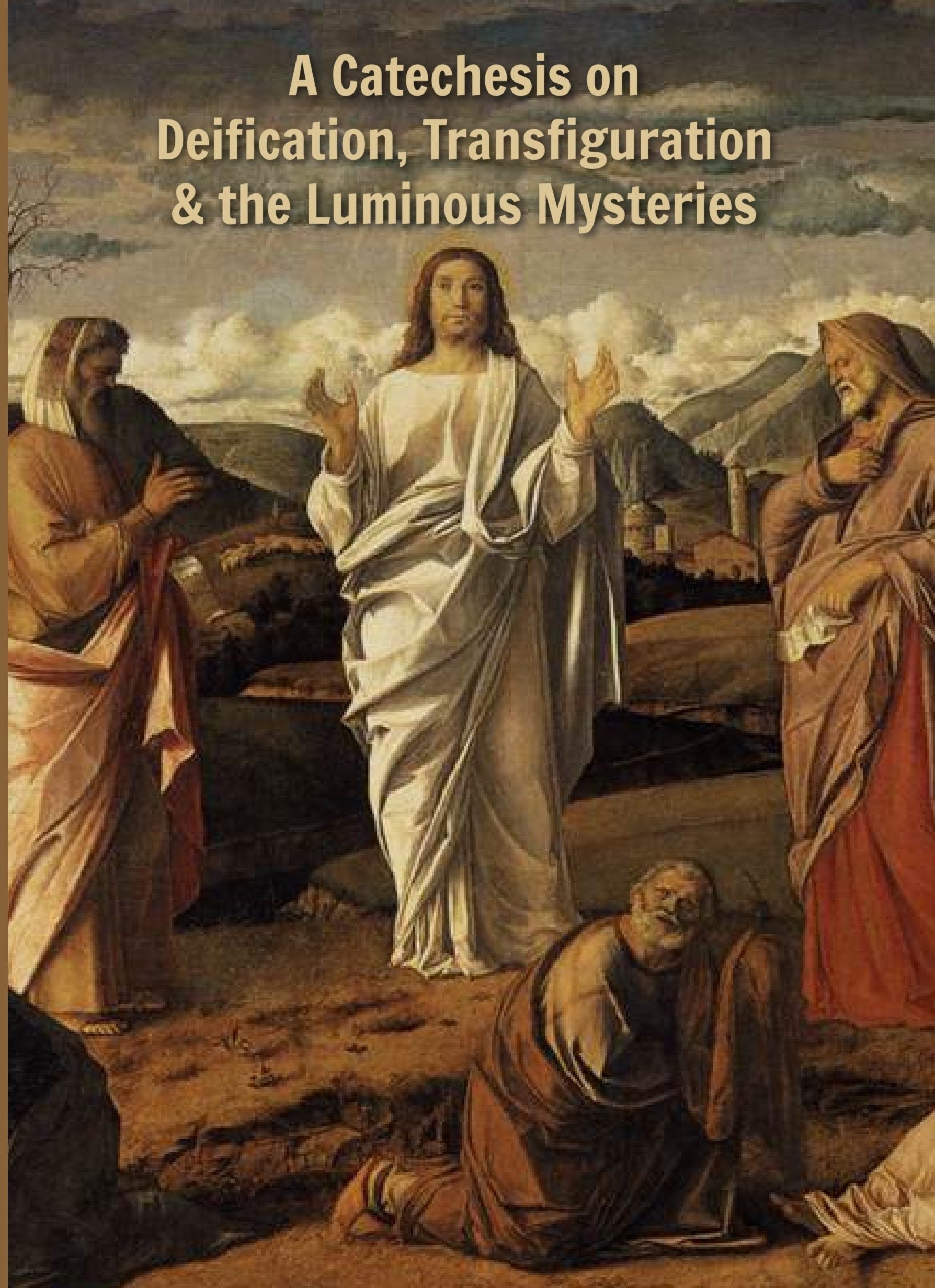
There is a moment in the Gospels which brings together all of the threads this essay has covered so far: the Transfiguration. This moment explains the entire notion of deification and the fulfillment of human desire in Christ. In Eden, God called man into His own eternal rest. On Sinai, God called Moses into His own cloud of glory and made him shine with His light for a time. Jesus, during His public ministry, at one point took Peter, James, and John aside to a high mountain to pray (Matt. 17:1). When they had ascended, Jesus was transfigured before them “and his face shone like the sun, and his garments became white as light” (Matt. 17:2). A bright cloud, the very same as appeared on Sinai, overshadowed them and the voice of the Father told them “’This is my beloved Son, with whom I am well pleased; listen to him’” (Matt. 17:5). This is a brief glimpse behind the veil at the divinity which has united to humanity in Christ Jesus. The apostles would not fully understand this moment until later. Here, it can be said that the entire doctrine of deification is justified. Notice that Christ was transfigured before the coming of the glory cloud, unlike Moses who received light from the cloud itself. Christ already has the fullness of God’s grace dwelling inside of Him because He is God. The cloud comes and from it the Father announces that this is His beloved Son, who has taken on human nature and glorified it in Himself to give the rest of mankind the sonship, by adoption, which He possesses by nature.
St. Peter and St. Paul emphasize man’s participation in the Transfiguration. In his second letter, Peter writes about having seen the Transfiguration with his own eyes (2 Pet. 1:16-18). It is in light of this revelation of Christ’s power that he says the same power has given man all things, even to the point of becoming “partakers of the divine nature” (2 Pet. 1:4). Peter’s vision of the Transfiguration formed in no small way the understanding he has of the promises of Christ, “all things that pertain to life and godliness” (2 Pet. 1:3). St. Paul, although he did not see the Transfiguration, knew Peter well and similarly to him called Christians “partakers of the Holy Spirit,” the Spirit of sonship which earlier showed how man becomes God by joining Christ as a son (Heb. 6:4). Peter and Paul affirm participation in Christ by the Holy Spirit along the very lines which Christ revealed at the Transfiguration.
VI. Conclusion.
The Christian life is not merely a boring or dreary slog to uphold external commandments. It is a deeper reality than many people are taught today. Man scarcely even gives credence to his own desires. Within every person is a desire for happiness and beatitude, which is only fulfilled by the infinite good of God and becoming like God. The ancients such as Plato recognized it and the Old Testament shows that God planted this desire within man’s nature for the purpose of fulfilling it. The Christian tradition down through the centuries has maintained that the way God fulfills man’s longing to become like Him is by taking on in the union of Person the nature He created, so that He may deify man from within. St. Athanasius, St. Maximus, and others consistently taught this very thing. Human nature is not destroyed in this process but ennobled and elevated. Human freedom is not dominated by an external will but reaches the good toward which is was ordered from the first moment of its existence. Then, at the right moment, Jesus Christ revealed to Peter, James, and John that the total fulfillment of all man’s desire is to be found in Him. The reality of the Transfiguration impacted those who saw it and should impact all who hear of it. The Creator of mankind came to walk among them, and in so doing bring the glorifying splendor of His divinity into the hearts of all who believe.
Cody Tucker is a student at Christendom College who will graduate this May 2026. Any errors in editing are the fault of his professor.
[For a brief popular book on the topic of deification, see: A Catechesis on Deification, Transfiguration and the Luminous Mysteries.]
[1]Jean-Paul Sartre, L’Entre et le Néant, Paris, 1943, 653f, quoted in Christoph Schonborn, From Death to Life: The Christian Journey, trans. Brian McNeil (San Francisco: Ignatius Press, 1995), 61.
[2]Plato, Plato’s Cosmology: The Timaeus of Plato, trans. and comm. Francis Cornford (Indianapolis, IN: Hackett Publishing Company, republished 1997), 29D-E, pp.23-33.
[3]Ibid., 29D-30A.
[4]Ibid.
[5]Francis Cornford, Plato’s Cosmology: The Timaeus of Plato, p. 34.
[6]Athanasius, On the Incarnation, para. 54, quoted in Christoph Schonborn, From Death to Life: The Christian Journey, trans. Brian McNeil (San Francisco: Ignatius Press, 1995), 41. Cf. Catechism of the Catholic Church #460.
[7]Ibid., 46-47.
[8]Athanasius, Second Discourse Against the Arians, para. 59, in Nicene and Post-Nicene Fathers, Second Series, vol. 4, ed. Philip Schaff and Henry Wace, trans. John Henry Newman and Archibald Robertson (Buffalo, NY: Christian Literature Publishing Co., 1892). New Advent (accessed November 18, 2025).
[9]Maximus the Confessor, Ad Thalassium #22, in On the Cosmic Mystery of Jesus Christ, trans. Paul Blowers & Robert Wilken (Crestwood, NY: SVS Press, 2003), 115.
[10]Schonborn, From Death to Life, 48.
[11]Ibid., 51.
[12]Ibid., 49.
[13]A. N. Williams, “Deification in the Summa Theologiae: A Structural Interpretation of the Prima Pars, The Thomist 61, no. 2, (April, 1997): 221.
[14]John of the Cross, Ascent of Mount Carmel, trans. E. Allison Peers, Book 2, Chapter 5, para. 6. Wikisource (accessed November 18, 2025).
[15]Maximus the Confessor, Ad Thalassium #22, p. 118.
[16]Servais Pinckaers, Pinckaers Reader: Renewing Thomistic Moral Theology (Washington D.C.: Catholic University of America Press, 2005), 138.
[17]Schonborn, From Death to Life, 54.